



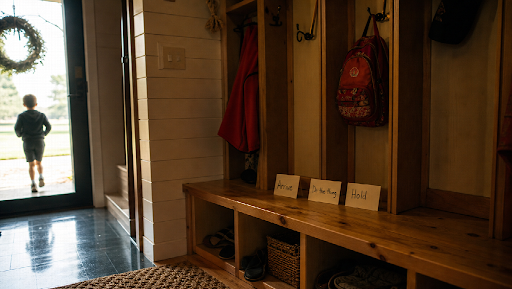
Kids in the House exists because parenting is easier to learn in motion than in a wall of text. The same gap shows up at home, at school, and in any waiting room that still hands a caregiver a PDF: the child does not read the PDF. A two-minute lecture does not land either. What often works is a short explainer — a beginning, a middle, a hold — in language a child can follow, with a room and a face they already know.
This is not a patient-education or medication article. It is not a substitute for a clinician. It is a production note for parents, teachers, counselors, and family-facing practices who need everyday orientation: first day of school, a new sibling, a calm-down corner, what the lobby looks like, who picks up on Thursday.
You do not need a desktop editor as the first move. You need a kit (your stills, your backpack, your hallway), a shot list so the story does not invent a second house, and two generation lengths: a 15–30 second scene for the “what happens,” and a 5–15 second punch for the group chat.
Three lanes, three jobs. One is a workspace. Two are models. Do not rank them as three rival apps.
Why a short video beats another handout
1. Children follow pictures and order, not jargon
“We will hang your coat, then sit on the rug” is a sequence. A paragraph about “classroom procedures” is not. A timed clip can show the coat hook, then the rug, then a still hold while you add a caption in your own words.
2. Caregivers are tired
The parent reading this between pickup and dinner will not open Premiere. They will photograph the backpack and write six seconds of direction if the tool respects that.
3. The same story has to travel
A classroom explainer also has to work in 9:16 for the class thread and 16:9 for the school site. That is a brief problem, not a font problem.
4. Access is captions and pace, not a louder narrator
Hard of hearing kids, new English speakers, and anyone watching with the sound off need on-screen language you control. Generate the picture. Add captions you approve. Do not outsource the wording of a sensitive family topic to a surprise voiceover.
5. Trust is your house, not a stock classroom
A generated “school” that is not your school teaches the wrong building. Use stills you own. Skip other people’s children unless you have permission.

Lane 1 — board the story before you spend the scene
A first-day clip fails the same way a short film fails: nobody wrote the order. “Make it friendly” is not a brief.
Film Studio is Topview’s cinematic production workspace: story development, storyboards, camera planning, performance direction, then scene generation, while you stay in the director seat. For a family explainer, finish a tiny packet first:
-
Three beats only (arrive, do the thing, hold)
-
One child look (the coat they will actually wear)
-
One place still (your door, your classroom rug, your clinic lobby — as a room, not as a procedure)
-
A “do not invent” list (no second parent, no extra siblings, no mystery playground)
Film Studio is not a model. It is the desk that keeps Tuesday’s pickup story from growing a new hallway. Sensitive topics — a move, a new baby, two homes — belong on paper before anyone generates a face.

Lane 2 — shoot the 15–30 second “what happens”
Once the board exists, the useful picture is a continuous beat: walk in, hang the bag, sit. Stitching five eight-second clips is how the backpack changes color.
Seedance 2.5 is a multimodal AI video model for coherent clips up to about thirty seconds from text plus image, video, and audio references, with timing and storyboard-friendly direction. Attach the stills you locked. Write seconds, not vibes:
“0–6s the same front door from the photo; 6–16s the same child in the red coat hangs the same backpack; 16–24s sits on the same rug; 24–30s hold for a caption — no new furniture, no extra kids.”
Review identity before “cute.” If second eighteen grows a different coat, fix the kit.
This lane is for the scene you will actually play on the couch: a rehearsal of tomorrow morning, a tour of the calm-down corner, a gentle “this is Grandma’s spare room.” It is not for dosage, diagnoses, or anything a clinician should say in person.
Lane 3 — the 5–15 second reminder for the thread
Class chats and fridge-door lives on first frames. You need a punch: same backpack, same door, a line of type, sound already in the file if you want a soft chime you own.
MiniMax H3 is a multimodal video model for short audiovisual clips from text plus image, video, and audio references, with native stereo output, roughly 5–15 seconds at up to 2K on hosted generators. Use it for:
-
“Yellow line, 3:10, same door”
-
A 10-second merch-free reminder of the water bottle
-
A hold of the calm-down pillow you photographed
Do not stitch ten punches and call it a lesson. Send the walk-through to Seedance 2.5. Keep H3 for the ping.

Practical family jobs (none of them are a prescription)
First day / new classroom. Board the hook, the coat, the rug. Generate one 20-second walk. Send an 8-second door punch to the parent thread.
Two homes, one routine. Same pajamas still in both packets. The story is the order of the evening, not a legal argument. Keep adults’ conflict off the soundtrack.
New sibling in the house. Show the bassinet and the big-kid chair you actually own. Do not generate a hospital procedure.
School counselor or OT-style space. Photograph the real corner. Generate a sit-and-hold so a child can preview the room. No treatment claims.
Family-facing clinic or dentist lobby. A waiting-room geography clip (“chairs, fish tank, you can bring a book”) is orientation. It is not pre-op teaching and not a medication tutorial. If a clinician needs a clinical video, that is a different article and a different duty of care.
How to start this week
-
Pick one hole: tomorrow morning, not “our whole parenting philosophy.”
-
Shoot five stills you have the right to use.
-
Write three beats on the Film Studio-style packet (even on paper).
-
Generate one Seedance 2.5 scene.
-
Generate one MiniMax H3 reminder from the same stills.
-
Add captions you wrote. Play it once with the child. If they correct the coat hook, believe them.
Hosted generation uses credits. Treat it like a short studio hour, not an unlimited cartoon mill. Stay off other families’ faces. Stay off anything in the “advice only a licensed professional should give” bucket.

Closing
The parenting internet is already a video library. The missing tape is usually the one that looks like your door. Board the order, shoot a 15–30 second beat that keeps the same child and the same bag, and keep a 5–15 second punch for the chat. That is family explainer work. It is not a pamphlet, not a feature film, and not medical care — and that is why a child might watch it twice.