



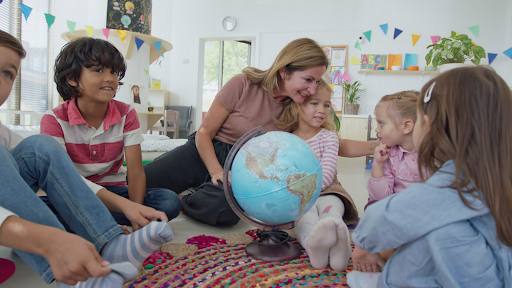
Raising children in a multilingual environment offers an array of benefits. It fosters cognitive development and builds cultural understanding, among other advantages. Applying Montessori principles to language learning creates a nurturing environment that supports the natural curiosity and independence of children.
The Montessori method emphasizes hands-on, self-directed learning that can be effectively applied to cultivating multilingual abilities in children. By introducing languages in a practical context, children gain exposure to diverse cultures and viewpoints. This harmonious blend of Montessori and multilingualism enriches children's educational experiences.
It's crucial to understand how multilingualism and Montessori philosophy together can ensure that children reach their full potential. Providing the right environment and using age-appropriate strategies are key components of this process. Let's explore the intersection of these methodologies and understand their impact on the growth of young learners.
Enhancing Academic Performance Through Multilingual Skills
Exposure to multiple languages from an early age significantly enhances children’s cognitive development. Various studies indicate that high school students engaging in foreign language studies tend to score higher on standardized tests like the American College Test (ACT). By mastering multilingual skills, children often develop improved decoding capabilities in language and mathematics.
The neural benefits of learning multiple languages manifest in advanced problem-solving abilities and logical reasoning. Children not only grow linguistically but also display sharper analytical skills, which are valuable across all academic disciplines. The Montessori approach, with its focus on self-directed learning, aligns perfectly with these cognitive gains.
Montessori classrooms encourage exploration and the pursuit of personal passions, creating a fertile ground for multilingual education. By allowing children to interact with languages through practical application and real-life communication, we prepare them for higher education and global interaction. The holistic academic benefits that result from this approach contribute to their overall success.
The Global Importance of Multilingualism
With nearly 7,000 languages spoken worldwide across 196 nations, multilingualism plays a critical role in global communication and cultural exchange. As our world becomes increasingly interconnected, the ability to communicate in multiple languages is more important than ever for children. Empowering them with these skills opens doors to understanding and embracing cultural diversity.
Montessori education fosters respect for all cultures, making it an excellent platform for raising multilingual children. By integrating cultural education into language learning, children develop empathy and global awareness from an early age. This knowledge not only benefits them socially and culturally but also prepares them for future professional opportunities.
Encouraging children to explore and cherish different languages helps bridge gaps between diverse communities. Moreover, they can better appreciate cultural narratives and historical contexts, enriching their worldview. Thus, a multilingual upbringing becomes a valuable asset in today’s diverse world.
Montessori Education: A Natural Fit for Multilingual Growth
Over 60,000 schools worldwide adopt the Montessori method, a testament to its enduring appeal and effectiveness. The method’s child-centered approach inspires children to take charge of their learning, fostering independence and self-motivation. Such an environment aligns naturally with a multilingual upbringing.
Montessori educators integrate language learning into various activities and subjects, making it an organic component of daily education. This immersive technique not only grounds language skills but also maintains the child's natural curiosity. Children come to view language learning as an extension of play, further enhancing their ability to absorb new languages effortlessly.
Through Montessori principles, children are given the freedom to explore languages at their own pace. This experiential learning advocates for mastery of content over mere exposure, resulting in profound multilingual competence. Thus, the fusion of Montessori and multilingual education equips children for future success by fostering a love for learning that extends beyond language itself.
Combining Montessori principles with multilingual education serves as a pathway to developing well-rounded, capable individuals. By providing children with the tools they need to understand and connect with the world, we lay the groundwork for lifelong success. This integration not only benefits their cognitive and academic development but also cultivates empathy and cultural appreciation.
As we continue to embrace an increasingly diverse and interconnected world, the advantages of raising multilingual children become clearer. The Montessori method provides the ideal environment to nurture these capabilities, ensuring children are well-prepared for the challenges and opportunities of the future. In doing so, we empower the next generation to thrive in a multilingual and multicultural global landscape.