



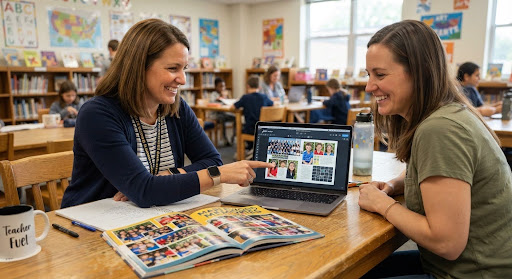
Someone has to order the yearbook. Usually, it is a teacher with no design background or a parent who said yes at the wrong moment. Then come the quotes, the minimum order counts, the contract that renews itself, and the deadline nobody warned you about. Choosing among the best yearbook companies gets much easier once you know which questions actually matter. Here is how the main options compare this year.
What makes a good yearbook company
Price per book is the number everyone asks about first, and it is rarely the number that decides whether the project goes smoothly.
Four things matter more. The first is whether you are locked into a contract. Some legacy publishers still ask schools to commit years in advance with a minimum order attached. The second is turnaround time, which ranges from two weeks to several months, depending on the company and the season. The third is how the software handles more than one person working on the book, because a yearbook built by a committee of five needs different tools than one built by a single teacher.
The fourth is sales. Collecting money from families is the part that quietly eats the most hours. Companies that run an online storefront and track preorders for you save more time than any design feature.
Keep your school's own situation in mind too. There are roughly 98,600 public schools in the United States, according to federal education data, and the needs of a 200-student elementary school and a 2,000-student high school with a journalism class have almost nothing in common.
1. Mixbook
If two parents and a phone full of field trip photos are making your yearbook, this option is the easiest place to start. There is no contract, no minimum, you have to guess at months ahead, and the design tools assume you have never made a book before.
For schools that want a simple setup, the ordering process is easy to manage. Speed and cost are where Mixbook does best: books arrive in two weeks or less, shipping is free on orders of ten or more, and templates and tools cost nothing. The company has printed more than 612,000 yearbooks for over 5,000 schools, with around 78 school themes you can recolor to match your logo and school colors.
The practical wins are the collaboration tools and the parent preorder system, which lets you collect payments online and watch the order count instead of chasing envelopes. Eligible schools also get 10% of yearbook sales back.
Where it is weaker: this is a photo book platform adapted for schools rather than a full scholastic publishing program. If you need index pages, senior portrait imports from a photography vendor, or a dedicated sales rep visiting your campus, look further down this list.

2. Jostens
Its long history gives it a strong foundation in school yearbooks. Jostens has been in schools for more than 125 years, and the depth shows. You can start with simple layout tools or move students into advanced design work, and the company will handle marketing and sales management alongside the printing.
The standout feature is Yearbook+, which lets each student upload ten photos of their own school year, digitally tied to their printed portrait. Your book gets more content without more printed pages, which matters when every page adds cost.
Jostens also publishes lesson plans for English and journalism teachers, so a yearbook class can double as curriculum. That is genuinely useful if the book is student-produced.
The tradeoff is formality. Expect a rep, a contract conversation, and deadlines set well in advance. For a small school with no yearbook class, that is more structure than you need.

3. Shutterfly
Most parents already have a Shutterfly account from making photo gifts, and that familiarity is the point. The design process is quick, the interface is one people have used before, and the price fits a preschool or K-2 memory book where nobody expects 80 pages.
There are fewer themes and fewer school-specific features than the dedicated yearbook companies offer. For a class book that mostly needs to hold thirty smiling faces and a few field trip photos, that is not a real loss.
The same skills transfer elsewhere, too. Parents who get comfortable with these tools often end up making photo books as gifts for grandparents using the same photo library. The photos are already organized and ready to use.

4. TreeRing
TreeRing built its reputation on two things: flexibility and personalization. There is no minimum order, so you print what you sell rather than eating a box of unsold books in June.
Every family can add two custom pages to their own child's copy. Your kid's soccer season and your family's version of the school year are all in the same book that everyone else gets. Parents tend to love this feature, and it is a strong selling point when you are pitching the yearbook at back-to-school night.
Students can also sign each other's books digitally, which solves the annual problem of books arriving after the last day of school.
5. Entourage Yearbooks
Entourage is built around support. Their Book Builder software is designed for people with no design experience, and help comes via phone, email, live chat, video, and webinars rather than through a single contact form.
If your committee falls apart in March, which happens more than anyone admits, their Special Project Assistance team can take the book over and finish the design for you. That safety net is the main reason to choose them.
Turnaround is fast compared to the legacy publishers, and contracts are not binding. The company has grown quickly through acquisitions, so ask specifically who your support contact will be.
6. Picaboo Yearbooks
Picaboo turns books around in about 15 days, making it the practical choice when the yearbook started late.
You can design in their Creator Studio or skip their software entirely and send a print-ready PDF, which suits schools with a teacher who already works in InDesign or Canva. Hardcover and softcover are both available, and orders can ship in bulk to the school or directly to families. You can also offer a digital copy alongside the print run.
The DIY approach is the downside. There is less guidance than Entourage or Jostens offers, so it works best when someone on your team already knows what they are doing.
7. Memory Book Company
Part of Jostens, Memory Book focuses on simple, affordable books for small groups: elementary schools, camps, homeschool co-ops, clubs. Softcover paperback binding keeps the per-book price low enough that nearly every family can buy one.
They offer five different design programs depending on how much control you want, or you can hand the whole project over and have them build it. Fundraising programs are available to help cover the cost, which matters when your budget is whatever the bake sale brought in.
|
Company |
Best for |
Contract required |
Turnaround |
|
Mixbook |
Elementary and parent-run teams |
No |
Two weeks or less |
|
Jostens |
Large high schools, journalism programs |
Typically yes |
Set by adviser deadlines |
|
TreeRing |
Personalized family copies |
No minimum order |
Standard |
|
Entourage |
First-time advisers needing support |
Non-binding |
Fast |
|
Picaboo |
Late starts and DIY designers |
No |
About 15 days |
|
Shutterfly |
Preschool and lower elementary |
No |
Standard |
|
Memory Book |
Small groups and homeschool co-ops |
No |
Standard |
What a school yearbook actually costs
Nobody publishes a single price, because the number depends on page count, cover type, and how many copies you order.
The three levers are binding, pages, and volume. Softcover is dramatically cheaper than hardcover. Every additional 8 pages usually bumps the price. And per-book cost drops sharply once you cross the volume thresholds, which is why bulk discounts commonly start around ten copies.
Ask every vendor the same three questions before comparing quotes. Are there setup fees? Is there a minimum order, and what happens if you miss it? Does student personalization, foil stamping, or a custom cover cost extra? A quote that looks cheap per book can lose to a slightly higher one once the extras land.
Many schools also treat the yearbook as a small fundraiser rather than a break-even project. If that is your plan, prioritize companies with revenue share or built-in fundraising tools over the lowest sticker price.
The photo permission rule most volunteers miss
This is the part that surprises new coordinators, and it is worth getting right before you upload any photos.
Student photos held by a school count as education records under federal privacy law. Schools can designate those photos as directory information, which allows them to appear in the yearbook without individual written consent, but families have to get an annual notice and a real chance to opt out.
What this rule means in practice: ask your school office for the current opt-out list before you start laying out pages, not after. Some families have asked that their child not appear in published materials, and pulling a face out of a spread at the proof stage is a bad afternoon.
The same rule applies to group shots pulled from a shared parent photo album. If a student is opted out, they should not be in the crowd photo either.
When to start, and what to lock in first
August or September, even if the book will not print until May.
The first month is not design work. It is deciding your page count, choosing a company, and putting a photo collection system in place. A shared cloud album that teachers and parents can drop photos into all year is the single biggest predictor of whether the book gets finished without panic.
Front-loading those decisions also makes the job realistic for volunteers with jobs, since staying involved at your child's school usually means picking one commitment and protecting it rather than saying yes to everything.
Set your internal deadline two weeks before the vendor's deadline. Something always comes in late.
Mistakes that cost schools money
Ordering too many copies is the most common one. Preorder first, print second. Companies with no minimum order exist specifically so you do not have to guess.
Choosing based on the per-book price alone is the second mistake. A cheaper book that arrives three weeks after the last day of school has cost you more than it saved.
The third is letting one person hold everything. If the only copy of the photo library is on one parent's laptop and that family moves districts in February, the project restarts from nothing. Use shared storage and give at least two people access.
Frequently Asked Questions
How much does a school yearbook cost per student?
It varies widely by format and volume, generally from under $10 for a short softcover to $50 or more for a hardcover with extras. Page count, cover type, and how many copies you order drive most of the difference. Always request a written quote that includes setup fees and shipping.
Do yearbook companies require a contract?
Some do and some do not. Legacy publishers like Jostens typically work on adviser agreements with set deadlines, while Mixbook, TreeRing, Picaboo and Shutterfly do not require schools to commit in advance. Ask directly, and ask whether the agreement auto-renews.
What is the best yearbook company for a small elementary school?
Look for no minimum order, free design tools, and simple software. Mixbook, TreeRing and Memory Book Company all fit that profile. Shutterfly works well for preschool and lower elementary class books where the page count is small.
How long does it take to get yearbooks delivered?
Two to three weeks with the faster companies and considerably longer with traditional publishers that set spring submission deadlines. Confirm the delivery window before you order, especially if you want books in hand before the last day of school.
Can parents help make the yearbook if they are not designers?
Yes. Every company on this list offers templates and drag-and-drop tools designed for people with no design background. Some also provide a done-for-you design service if your committee runs out of time.
Do we need permission to put a student's photo in the yearbook?
Schools can designate student photos as directory information, which allows their use in the yearbook without individual written consent, but families must receive annual notice and be able to opt out. Get the current opt-out list from your school office before you begin.
How many pages should a school yearbook be?
There is no standard. Small elementary books often run 20 to 40 pages, while large high school books can run well past 200. Start with a template, sketch what you need to cover, and let the content set the page count.
When should we start planning the yearbook?
At the start of the school year. The first month goes to choosing a vendor, setting a page count, and creating a shared photo album that teachers and parents can add to all year.
Can families order yearbooks online instead of sending money to school?
Most companies now offer an online storefront where families order and pay directly. Some also let organizers track preorders in real time, which removes the cash collection problem entirely.
What if we sell fewer books than we ordered?
You absorb the cost of the unsold copies. Choose a company with no minimum order and run preorders before printing to avoid this scenario.
Is a digital yearbook worth adding?
It can be, particularly for families who miss the ordering window or want to share the book with relatives far away. Several companies offer a digital copy alongside the print run at low cost.
Picking the right one
The yearbook company that works for your school depends less on rankings than on who is actually making the book. A parent volunteer with a full-time job needs different things than a journalism teacher with a class of twenty students and a semester of deadlines.
Narrow it down by contract terms and turnaround first, then compare quotes with the extras included. Start the conversation in the fall, and the book will be one of the easier things on your list by spring.