



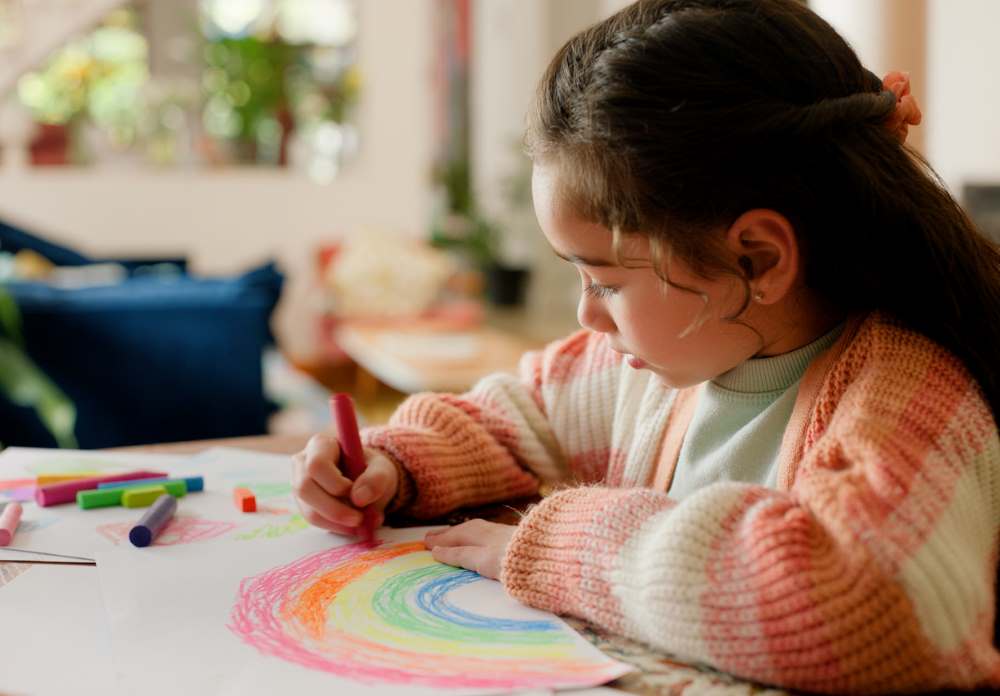
Don't want to spend a fortune to get your kid's creativity going?
Home hobbies are the answer. Here's how to set them up for maximum effect.
The Problem
Creativity levels have dropped in half since 1990. Most alarmingly, kindergartners through third-graders have experienced the steepest decline.
The good news is that home hobbies and play activities are the fastest way to help your child regain the superpower of imagination.
What you'll discover:
- The Critical Role of Home Hobbies
- The Most Effective Home Activities for Creativity
- Establishing Lasting Creative Hobbies
- Home Space Essentials
The Critical Role of Home Hobbies
Home hobbies are more than just killing time. Research suggests they lay the groundwork for higher self-esteem levels in adolescence.
Every little bit helps, of course, but these stats on creative activities at home show you that you don't need to break the bank to support your child's development.
Curiously…
Across the Australian population, 94% of children aged 5 to 14 years participated in a cultural activity outside of school hours in the 12 months before being interviewed.
Creative activities and visual arts dropped from 63% participation to 59% between 2017-18 and 2021-22.
It's still a majority, but less and less kids these days are engaging in creative and artistic activities.
Your child could be part of the solution instead of the problem.
The Most Effective Home Activities for Creativity
Ok, let's not get hung up on the soft stuff. The real question is what activities at home really deliver. Here are some ideas and if parents need help with brainstorming ways to get their kids involved, Calgary Play Therapy can help.
Creative Home Hobbies #1 – Arts & Crafts
By far, arts and crafts activities are the most common form of creative activity in children with 39% participation at least once per week.
It's for good reason too. Simply:
- Drawing/painting
- Paper crafts/origami
- Clay modeling/sculpting
- Collage-making
It works.
Give your kid some paper and a few crayons and get out of their way. There's plenty of useful resources like these free coloring pages for kids to get you started.
Creative Home Hobbies #2 – Music & Movement
Creative music activities like singing and playing musical instruments take second place with 19% of children regularly participating.
The beauty of music hobbies at home is that you don't need to buy high-end instruments.
To start, focus on:
- Percussion instruments
- Singing games/karaoke
- Dancing/movement
- Make your own instruments from household items
Creative Home Hobbies #3 – Storytelling & Writing
Storytelling and creative writing also attracted 19% of children for creative activities.
Activities at home include:
- Picture book creation
- Short stories
- Comic strips
- Recording family stories/memories
Establishing Lasting Creative Hobbies
Too many parents try to squeeze creative activities into a busy schedule and treat them like one-off events.
The mistake they make is not nurturing creative habits over the long haul.
Little and often is better than occasional big dabs.
Tips for making creative hobbies at home a habit:
Start small.
Pick one activity and commit to it regularly.
30 minutes of drawing each Sunday afternoon. 15 minutes of story writing each Wednesday.
The exact duration isn't the point. What's critical is creating a sense of routine.
Make it social.
Creative activities are more engaging if the whole family is involved.
Evidence even suggests children's creative activities have a larger impact on outcomes when they engage in them with caregivers.
That means less time on solo screen-time and more collaborative art and craft projects.
Escape the results-driven trap.
Creativity isn't about producing museum-quality artwork or the next Pixar short. It's about creative thinking and problem-solving.
The process matters far more than the outcome. Creativity is trying things out, learning, and experimenting.
Emphasize effort over results.
Say things like "I love how you experimented with those colors" not "why is that blue?"
Provide the materials and space.
It's your child's hobby not yours. Your role isn't to be the creative director.
The rule of thumb is 1:10. Give ten minutes of interest/focus and your child. Let them lead the way.
Home Space Essentials
A special space for creative activities doesn't need to be a Pinterest-worthy studio.
It just needs to be somewhere your child has permission to create and experiment with a reasonable expectation that they won't be asked to clean up immediately afterwards.
Tips on setting up a space for creative home hobbies.
Good lighting.
Natural light is best but whatever is available. When you position the space, ensure that there are no shadows from other objects on the main work surface.
Easy clean surfaces.
Wood or laminate is preferable to carpet and something wipeable is best. Avoid placing the activity area too near food preparation areas.
Storage.
Shelves for materials/projects in process.
A pegboard is even better for display.
Display.
Kids love seeing their work up on a wall. It's a visual reminder that what they create is worth sharing.
Easy Access to Supplies
Ensure that the hobby materials are within your child's reach.
Little prompts to get creative.
No need to lay everything out for them, but providing supplies that are easy to access without needing adult intervention encourages spontaneous creativity.
Stock Up on the Basics
Paper.
Every size and shape and color you can get your hands on.
Markers/crayons/colored pencils.
Water-based. Don't kid yourself with magic markers, you and your carpet will be grateful.
Glue sticks/tape.
PVA glue is the best.
Child-safe scissors.
Regular safety scissors for preschool and below. YouTubers make it look more dangerous than it is.
Basic craft supplies.
Pom-poms, pipe cleaners, feathers, fabric, googly eyes, stickers.
From here, you can curate more targeted materials, but a few simple craft supplies will go a long way.
The 90% Rule
Kids, screen-time, it's not going away. For better or worse, creative activities involving digital media are now part of the mix.
The key is to have balance.
If 90% of creative activity participation involves some kind of screen-time, use it.
- Drawing apps/digital art.
- Music composition/maker.
- Video storyboarding and creation.
- Online tutorials for new skills/techniques.
But remember, hands-on crafts, drawing, music, and story writing remain at the core.
Encouraging Lasting Creativity
There's a difference between a fun afternoon at home and a lasting creative habit.
The former doesn't require much in the way of infrastructure. The latter is more consistent and requires more from you and your child.
The solutions that work:
- Creative routines.
- Bedtime is a routine so creative time is too.
- Daily after school.
- Weekend family projects.
- Capture the process.
Take photos of works in progress as well as finished pieces.
It helps kids see that a creative activity is a process, not an event.
Focus on the process.
Emphasize how they do the activity, not what they produce.
Praise experimentation.
Highlight the learning, not the execution.
Creative Activities = Learning Activities
Home hobbies and play blur the line between learning and creativity.
Creating a comic strip improves skills in design, drawing, writing, storytelling, and problem-solving.
It's why, on average, homeschooled students participate in 5 extracurricular activities a week.
Evidence that creative activity builds academic skills.
Drawing/painting.
Art projects boost geometry, spatial reasoning.
Music.
Music hobbies have a correlation with math and patterns.
Story creation.
Storytelling builds language, communication.
Craft projects.
Craft projects develop fine motor skills.
Learning the Hard Way
"They lose interest so quickly…"
Normal. Don't try to force them to stay with a hobby for months on end. Rotate through different hobbies.
"Messy…"
Deal with it.
Set some rules about where this can happen, then have a slightly looser attitude. Remember the point is exploring and making mistakes.
"I'm not creative myself…"
Nor need you be.
It's your job to provide the space/time/materials for your child to create at home. They don't need a parent with a creative portfolio.